| Deksha Samskara :👈 | 👉:Philosophy-Behind-Dīkṣā |
Procedure of Ishtalinga Initiation (ಇಷ್ಟಲಿಂಗ ದೀಕ್ಷಾ ಪ್ರಕ್ರಿಯೆ) |
- ✍ Her Holiness Dr. Maate Mahadevi.
Method of Ishtalinga Initiation (Lingadeeksha)
Whether for girls or boys, the stage when they leave childhood and enter youth or maidenhood is extremely important. This is the period when the body undergoes complete transformation. Therefore, for a child who received Lingadharana (wearing of the Ishtalinga) at birth, Lingadeeksha (formal initiation into the Ishtalinga) is now performed.
For girls, Lingadeeksha is generally conducted when they attain puberty, and for boys, between the ages of 12 and 16.
There is an entire chapter in Shoonya Sampadane in which Channabasavanna prays to Guru Basavanna for initiation and receives his blessings. Akka Mahadevi too had undergone Lingadharana at birth:
ಗುರುವಿನ ಕರುಣದಿಂದ ಲಿಂಗವ ಕಂಡೆ, ಜಂಗಮವ ಕಂಡೆ
ಗುರುವಿನ ಕರುಣದಿಂದ ಪಾದೋದಕವ ಕಂಡೆ, ಪ್ರಸಾದವ ಕಂಡೆ,
ಗುರುವಿನ ಕರುಣದಿಂದ ಸಜ್ಜನ ಸದ್ಭಕ್ತರ ಸದ್ಯೋಷ್ಠಿಯ ಕಂಡೆ
ಚನ್ನ ಮಲ್ಲಿಕಾರ್ಜುನಯ್ಯಾ,
ನಾ ಹುಟ್ಟಲೊಡನೆ ಶ್ರೀಗುರು ವಿಭೂತಿಯ ಪಟ್ಟವ ಕಟ್ಟಿ
ಲಿಂಗಸ್ವಾಯತವ ಮಾಡಿದನಾಗಿ, ಧನ್ಯಳಾದೆನು.
“Through the Guru’s grace I beheld the Linga, I beheld the Jangama.
Through the Guru’s grace I received Padodaka and Prasada.
Through the Guru’s grace I saw the holy assembly of noble devotees.
O Channa Mallikarjuna,
As soon as I was born, the revered Guru tied the sacred Vibhuti mark upon me
And made me one with the Linga; thus I became blessed.”
Later, she again receives Lingadeeksha. This clearly establishes that both Lingadharana and Lingadeeksha are essential for a follower of the faith.
Until recently, this practice continued in the old Mysore region, though it appears to have disappeared in North Karnataka.
Lingadharana may be compared to an engagement before marriage, while Lingadeeksha is like the marriage itself. Just as there is no true husband-wife relationship if only an engagement takes place without marriage, similarly the relationship between God and devotee remains incomplete without Lingadeeksha.
Following Lingayat Dharma does not come merely by birth; it comes through conscious acceptance.
In an engagement ceremony, the parents of the bride and groom mutually discuss and agree. Likewise, during Lingadharana, the child’s parents take vows on behalf of the child. But in marriage, the bride and groom themselves directly take vows. Similarly, in Lingadeeksha, the devotee personally takes vows in the presence of the Guru.
Those not born into Lingayat families would not have undergone Lingadharana in childhood; they voluntarily receive initiation later. Such persons are considered noble, like women who marry directly without an engagement ceremony.
On the other hand, Lingayats who undergo Lingadharana but never receive Lingadeeksha are considered incomplete, like a girl who is only engaged but never married.
Lingadharana performed for a child may be compared to the Christian rite of Baptism, while Lingadeeksha may be compared to Confirmation performed for older children. Is it not greater for a person to personally take vows rather than merely live according to promises once made by their parents on their behalf? Therefore, everyone should necessarily receive Lingadeeksha.
Since Lingadharana is a traditional ritual, it may be performed by a priest, by a well-cultured Sharana when no priest is available, or even by elders of the family. However, Lingadeeksha should ideally be received from enlightened, devoted, and spiritually disciplined followers of the Basava path.
It should be remembered that this is a life-transforming rite. Therefore, one should seek a worthy Guru and receive initiation when such a Guru is found.
Even those who, due to ignorance or lack of understanding, did not receive initiation before the age of sixteen may still receive Lingadeeksha later in life whenever they encounter a suitable Guru. There is no age limit.
Ishtalinga Deeksha (Lingadeeksha)
Lingadeeksha is a highly significant sacrament. In Vedic religion, the Upanayana initiation is considered extremely important and is performed compulsorily. Invitations are even printed and relatives formally invited.
Linga Deeksha Ceremony – Invitation Letter Sample
Om Shri Gurubasava Lingayanamaha
After transcending all limitations, He revealed the Infinite Brahman
Again and again upon the palm of the hand.
Though dissolved into the countless worlds, He remains immeasurable.
O virtuous Shri Guru Basava Yoginatha!
Invitation to the Linga Deeksha Ceremony
Respected Sharana relatives and devotees,
Wearing the Ishtalinga, the symbol of the Universal Spirit in the form of the cosmos, is the foremost practice of the Lingayat faith. The Linga Deeksha ceremony, through which one receives the Ishtalinga — the noble gift of World Teacher Basavanna — through the Guru, is one of the most important events in life.
The Linga Deeksha ceremony of our child/children ............................................................... will be conducted by the revered .....................................................................................
Following the chanting of the Basava-Linga mantra and the initiation discourse, there will be an “Ishtalinga Philosophical Teaching” session. The revered Guru will explain the philosophical background of the Ishtalinga and the importance of Shivayoga spiritual practice.
We wholeheartedly request you to grace this occasion, receive the Mahaprasada that we shall offer in the spirit of Dasoha, and become recipients of the grace of World Teacher Basavanna.
Address:
..........................................................
..........................................................
With Sharanu and humble regards,
Sharana / Sharane ....................................................
........................................................
Similarly, conducting Ishtalinga Deeksha (Lingadeeksha) ceremonially is considered a must. This helps fellow followers understand its importance and encourages them to observe it as well.
At present, within Lingayat society, there is often little seriousness, devotion, or sense of obligation regarding Ishtalinga Deeksha (Lingadeeksha). Therefore, families who have the means should treat it as an important spiritual rite, organize it specially, invite Gurus, and bring public attention to its significance.
Those without financial means may go directly to where Gurus reside and receive initiation there. Wealthier people, when inviting revered Gurus to their homes for initiation ceremonies, may also help poorer families receive initiation.
Organizations and associations may also arrange special collective initiation ceremonies, conducting group Ishtalinga worship and Ishtalinga Deeksha (Lingadeeksha) programs. This would greatly benefit economically struggling families and is considered highly praiseworthy.
Some people spread the belief among innocent devotees that initiation must be received only from members of a particular Guru lineage, and that initiation given by others will bear no fruit. This is incorrect. Guruship and Jangamaship are not limited to any caste or group. Anyone who has themselves attained the state of Guru through the Guru’s grace may give initiation blessings.
Some ascetics, on the other hand, do not themselves give initiation but instead direct followers to members of traditional Guru lineages. This too is considered incorrect. Since Gurus and Jangamas attain their status through spiritual qualification, it is proper that they themselves give Ishtalinga Deeksha (Lingadeeksha) to their followers.
There are also some who, without proper understanding themselves and without teaching anything correctly, still give initiation. Such people say:
“Initiation is like marriage; it happens only once. One should not again receive blessings from another Guru.”
Later, when devotees encounter enlightened Gurus who explain everything properly and make them understand clearly, they naturally develop the desire to receive initiation from such realized teachers, and mental conflict begins within them.
An initiation received in childhood, without understanding and without proper awareness, may not be very fruitful. Therefore, there is nothing wrong if, after attaining understanding and conviction, one later receives initiation blessed by enlightened Gurus along with conscious spiritual resolve.
However, if the person who first gave initiation was not enlightened but was still virtuous, sincere, and devoted in worship, then it is sufficient for the devotee later to regard the realized saint they encounter as a *Shiksha Guru* (teaching Guru) or Jnana Guru (Guru of wisdom), receive Karuna Prasada from them, and obtain blessings by having the Guru place a hand upon their head. In such cases, receiving initiation again is not necessary.
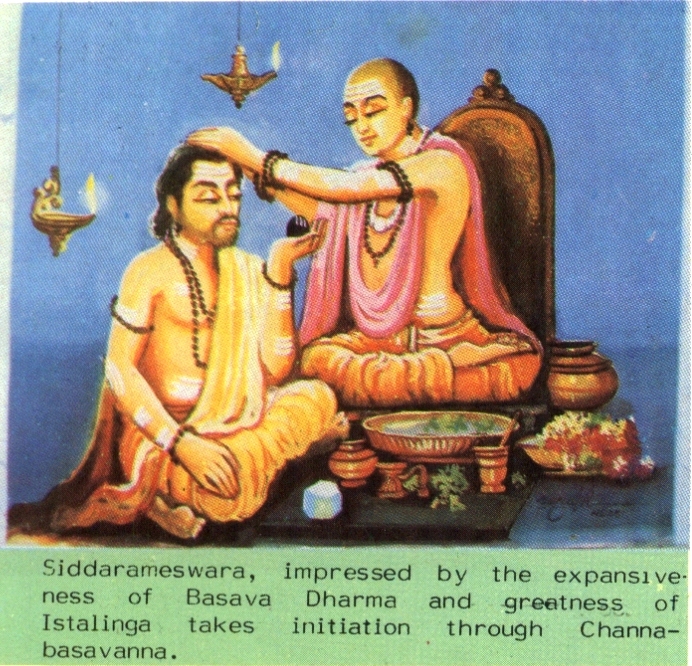
Method of Ishtalinga Initiation (Lingadeeksha)
Those who are to receive initiation should, on the day of initiation, bathe by pouring water over the head, wear clean ritual clothes, and come without consuming any food—not even tea, milk, or coffee. They should bring the required worship materials along with them.
Required Materials
- An Ishtalinga to be worn, along with its cord or necklace.
- A Karadige (container) , cloth, or small cloth pouch for wearing the Ishtalinga.
- A portrait of Guru Basavanna.
- A vow chart and books containing the methods of worship and Sri Basaveshwara Pooja Vrata.
- Sacred ash (Vibhuti), Rudraksha beads, and sacred thread (Shivadara).
- A rosary (Japamala) made of Rudraksha or Bhadraksha beads.
- Incense sticks and camphor.
- Leaves and flowers for worship.
- Bananas or sugar. Or Dates or other fruits as per availability.
- An offering for initiation according to one’s capacity.
All these items should be arranged neatly on a plate and brought.
The disciple should enter the worship hall where the Guru is seated, bow down kneeling, and sit along with the other initiation seekers.
The Guru completes his bath and comes wearing clean ritual clothes. If there are only one or two disciples, the Guru may give initiation while remaining fasting. If many disciples are present and the process requires much time, then if the Guru is elderly or unwell, he may first complete his morning worship and take a light refreshment or milk, then bathe again or wear fresh ritual clothes before conducting the initiation.
The Guru should first perform Ishtalinga worship himself while explaining the process to the disciples. Giving initiation without teaching the method of worship is useless—it is like giving a mirror to someone in darkness. (For the method of Ishtalinga worship, see the book *Deva Pooja Vidhana*.) After worship, the Guru first receives the Theertha and Prasada himself.
Followers steadfast in Linga devotion should be instructed that, instead of worshipping many gods and goddesses or falling into the worship of minor deities for fulfillment of worldly desires, they should fulfill their wishes through Ishtalinga worship and Basaveshwara worship observances alone. The Guru should teach the methods of Sankalpa Japa (vow-based chanting) and collective chanting.
For marriage, childbirth, progress in work, success in business, or any desired objective, Sankalpa Japa is considered beneficial. This means making a resolve such as:
“Until this objective is fulfilled, I shall chant this mantra a certain number of times.”
The Guru conducts collective mantra chanting and then sprinkles Theertha upon the Ishtalinga three times, collecting that sacred water in a vessel.
Afterwards, worship is offered to the portrait of Guru Basavanna, Mangala is performed, and Basava Manthrodaka (or Hastodaka) is prepared. This is mixed with the Ishtalinga Theertha and kept aside.
Sometimes the household that invited the Guru for initiation wishes to perform Padapooja (worship of the Guru’s feet). After Guru Basava worship and Ishtalinga worship are completed, the Guru allows this. The devotees collect the water sanctified by washing the Guru’s feet (Padodaka or Angushthodaka) into a vessel and mix it into the Theertha vessel, covering it with a cloth. Thus the sacred waters of Guru, Linga, and Jangama become united.
The Guru now takes the disciple’s Ishtalinga and personally worships it. First pure water is sprinkled. Then the Guru–Linga–Jangama Theertha is sprinkled. According to the regular method of Linga worship, ablution is performed, a pentagonal symbol is drawn upon the palm, and the Linga is placed there. Sacred ash is applied, sandal paste placed, sacred rice offered, leaves and flowers offered, incense waved, lamps shown, food offerings placed, Arghya offered, the bell rung, and salutations performed with the Kuranga Mudra gesture.
After the eightfold worship (Ashtavidha Archane), the Guru fills the Linga with spiritual consciousness (Chitkala) through Trataka (steady yogic gazing). Holding a noble spiritual resolve within the mind, the Guru establishes that resolve into the Ishtalinga through the power of vision. This consciousness-filled Ishtalinga is then given to the disciple to wear.
If there are only one or two disciples, the Guru performs the worship and Trataka with the Ishtalinga placed upon his own palm. If there are many disciples, the Ishtalingas are arranged in order upon a small tray corresponding exactly to the seating order of the disciples. (Care must be taken that those seated do not change places.) Worship and Trataka are then performed collectively.
The Guru first pours some Theertha from the vessel into the right hand and sprinkles it upon the disciple’s head. Then the disciple is given the sugar candy offered as Naivedya to the Linga.
Next, three horizontal lines of sacred ash are applied upon the forehead three times while chanting:“Om Shri Guru Basava Lingaya Namah.”
A Rudraksha bead tied upon the sacred thread (Shivadara) is then placed around the disciple’s neck. (Later, this may be attached to the Karadige thread. Those wearing the Linga in cloth may separately wear Rudraksha.)
A pentagonal Pranava symbol is drawn upon the left palm while chanting: “Om Lingaya Namah.”
The Ishtalinga is placed upon the central Pranava seat so that the knot upon the cord faces the thumb. Since the worshipper seated in Shambhavi Mudra is worshipping his own inner self, the Linga is positioned in alignment with his own seated posture. The symbol indicates the presence of the sacred fivefold structure within the Linga.
The Guru places the Ishtalinga upon the disciple’s palm once more, applies sacred ash, flowers, and other offerings, and places sugar candy as Naivedya.
Now the Guru places the right hand upon the disciple’s head—upon the *Sahasrara Chakra*—and, with deep feeling and awakened spiritual resolve, silently descends the grace and spiritual power through *Shaktipata* while chanting:
“Om Lingaya Namah.”
The disciple too, with devotion and closed eyes, repeats the mantra while inwardly receiving that grace and power.
The Guru whispers the mantra either 12 times, symbolizing the Guru Basava mantra, or 9 times symbolizing the awakening of the nine chakras.
Finally, as complete blessing, the Guru places both hands upon the disciple’s head and silently meditates upon the mantra while gazing affectionately upon the disciple, transmitting divine grace and resolve through vision.
The disciple who has received mantra instruction should sit upright, raise the left palm holding the Ishtalinga about twelve finger-widths away from the nose, and gaze steadily at it with half-open eyes—not fully open nor fully closed. Holding a rosary in the right hand (made of Rudraksha, Bhadraksha, or Chakravaka beads), the disciple mentally chants:
“Om Lingaya Namah.”
once for each bead moved.
At least 108 repetitions should be completed (one full round of the rosary), after which Linga meditation should begin.
The Guru then proceeds to give initiation and mantra instruction to the next disciple.
Linga Meditation
Linga meditation means placing the left palm containing the Ishtalinga upward, supporting it from below with the right palm, resting both hands upon the lap level with the navel, turning the gaze inward, and mentally meditating upon: “Om Lingaya Namah.”
The two most important aspects of Ishtalinga Yoga are:
* Trataka Yoga (steady gazing)
* Linga Meditation
Ordinary devotees are generally told simply to chant the mantra 108 times while performing Trataka. This rule is intended for people who lack the patience for deeper practice. It does not apply to spiritual aspirants deeply interested in yogic discipline.
Even after completing the formal 108 repetitions with the rosary, such aspirants should continue gazing at the Linga with half-open eyes for as long as the mind remains joyful and the body can comfortably sit. Here, counting is not important—practice is important.
In Linga meditation, closing the eyes and fixing the inner gaze is essential, and regulation of breathing is extremely important.
The gaze should be fixed either:
* at the Bhrumadhya (center between the eyebrows), or
* at the Hridaya Kamala (heart lotus).
How are these centers identified? If both eyeballs are turned upward toward the upper center, the gaze fixes at the Bhrumadhya. If turned downward, it settles at the heart lotus.
With the gaze fixed thus, breathing should become:
* slow,
* equal,
* and deep.
The duration of inhalation and exhalation should be equal. Along with the breath, the six-syllabled mantra:“Om Lingaya Namah.”
should flow throughout the body. One should feel that the mantra is descending through the breath into every part of the being. This meditation helps internalize the bliss experienced during Trataka Yoga.
After completing mantra instruction, the Guru should then teach the vows (Pratijna). A written chart of these vows should always be kept by followers of Basava Dharma for regular contemplation.
Twelve Oaths of Basava (Lingayat) Dharma Followers
Om Shri Guru Basava Lingaya Namah
“In the witness of Dharma Guru Basavanna, in the witness of the Supreme Creator of the universe, and in the witness of all the sharanas, I accept this vow.
I surrender to Shri Guru Basava, I surrender to Lord Linga, I surrender to the assembly of sharanas, and I have attained the state of the gana.”
| 1 | OM (ಓಂ) | I believe in the existence of the Creator who made the universe. I surrender believing that He alone is the supreme power. |
| 2 | Shri (ಶ್ರೀ) | I place my faith in and surrender to Dharma Guru Basavanna, the divine emissary sent by God for the spiritual upliftment of humanity, born of divine grace and revered as the universal protector. |
| 3 | Gu (ಗು) | I accept the Vachana literature revealed by Guru Basavanna, the primal sharana, together with his contemporaries and the lineage of sharanas, as my religious code, and I commit myself to walking the sharana path. |
| 4 | Ru (ರು) | I shall faithfully wear the Ishtalinga, the symbol of the universal soul shaped by the Dharma fathers, and worship it daily with devotion. |
| 5 | Ba (ಬ) | I accept the divine field of Kudala Sangama, revealed by Dharma father Basavanna, as our sacred religious center and will visit it. |
| 6 | Sa (ಸ) | At least one day in every week, I shall join the company of sharanas, remember the Lord, praise the Dharma fathers, and participate in spiritual gatherings and experience-sharing assemblies. Every year, on Shivaratri, I will certainly take part in the local gana gathering. |
| 7 | Va (ವ) | I will earn wealth through truthful and pure work, and use it through the principle of dasoha (selfless sharing) for the upliftment of religion and society. |
| 8 | Lim (ಲಿಂ) | Every year, I will come to the Basava revolution day gathering at Kudala Sangama, the place of Basavanna’s learning, tapas, and union. At least once in my lifetime, despite all difficulties, I shall attend and affirm my religious commitment. |
| 9 | Ga (ಗಾ) | I will not desire others’ wealth or others’ wives. |
| 10 | Ya (ಯ) | I will not consume meat or alcohol. |
| 11 | Na (ನ) | I shall regard those of my own faith as spiritual brothers and sisters, and those of other faiths as friends, and I shall treat them with respect. |
| 12 | Maha (ಮಃ) | According to the vision of the Dharma fathers, I will faithfully strive to establish in this mortal world a divine welfare kingdom free from caste, color, and class divisions. |
| 1 | ಓಂ | ಜಗತ್ತನ್ನು ನಿರ್ಮಾಣ ಮಾಡಿದ ಸೃಷ್ಟಿಕರ್ತನ ಅಸ್ತಿತ್ವದಲ್ಲಿ ನಂಬಿಕೆ ಇಡುತ್ತೇನೆ. ಅವನು ಒಬ್ಬನೇ ಮತ್ತು ಪರಮೋನ್ನತ ಶಕ್ತಿ ಎಂದು ನಂಬಿ ಶರಣಾಗುತ್ತೇನೆ. |
| 2 | ಶ್ರೀ | ವಿಶ್ವಗುರು ಬಸವಣ್ಣನವರು ದೇವರು ಲೋಕೋದ್ಧಾರಕ್ಕಾಗಿ ಕಳುಹಿಸಿ ಕೊಟ್ಟ. ಪ್ರತಿನಿಧಿ, ಕಾರಣಿಕ, ದೇವರ ಕರುಣೆಯ ಕಂದ, ನಮ್ಮೆಲ್ಲರ ರಕ್ಷಕ ಎಂದು ನಂಬಿ ಶರಣಾಗುತ್ತೇನೆ. |
| 3 | ಗು | ಗುರು ಬಸವಣ್ಣನವರೇ ಆದಿ ಪ್ರಮಥರಾಗಿ, ಅವರ ಸಮಕಾಲೀನರು ಮತ್ತು ಅವರ ಪರಂಪರೆಯ ಶರಣರು ಕೊಟ್ಟ ವಚನ ಸಾಹಿತ್ಯವೇ ನನ್ನ ಧರ್ಮ ಸಂಹಿತೆ ಎಂದು ತಿಳಿದು ಶರಣ ಪಥದಲ್ಲಿ ನಡೆಯುತ್ತೇನೆ. |
| 4 | ರು | ಧರ್ಮಪಿತರು ವಿಶ್ವದಾಕಾರದಲ್ಲಿ ರೂಪಿಸಿಕೊಟ್ಟ ವಿಶ್ವಾತ್ಮನ ಕುರುಹಾದ ಇಷ್ಟಲಿಂಗವನ್ನು ಶ್ರದ್ಧೆಯಿಂದ ಧರಿಸಿ, ನಿಷ್ಠೆಯಿಂದ ನಿತ್ಯವೂ ಪೂಜಿಸುತ್ತೇನೆ. |
| 5 | ಬ | ಧರ್ಮಪಿತ ಬಸವಣ್ಣನವರು ಬಯಲಾದ ದಿವ್ಯಕ್ಷೇತ್ರ ಕೂಡಲ ಸಂಗಮವನ್ನು ನಮ್ಮ ಧರ್ಮಕ್ಷೇತ್ರವೆಂದು ನಂಬಿ ಸಂದರ್ಶಿಸುತ್ತೇನೆ. |
| 6 | ಸ | ಏಳು ದಿವಸಗಳ ವಾರದಲ್ಲಿ ಒಂದು ದಿವಸವಾದರೂ ಶರಣರ ಸಂಗದಲ್ಲಿ ಸೇರಿ ಕರ್ತನನ್ನು ಸ್ಮರಿಸಿ, ಧರ್ಮಪಿತರನ್ನು ಕೊಂಡಾಡಿ, ಗಣ ಮೇಳಾಪ-ಅನುಭವ ಗೋಷ್ಠಿಯಲ್ಲಿ ಭಾಗಿಯಾಗುತ್ತೇನೆ. ಪ್ರತಿವರ್ಷವೂ ಶಿವರಾತ್ರಿಯಂದು ಸ್ಥಳೀಯವಾಗಿ ನಡೆಯುವ ಗಣಮೇಳದಲ್ಲಿ ತಪ್ಪದೆ ಭಾಗಿಯಾಗುತ್ತೇನೆ. |
| 7 | ವ | ಸತ್ಯ ಶುದ್ಧ ಕಾಯಕದಿಂದ ಧನವನ್ನು ಸಂಪಾದಿಸಿ ದಾಸೋಹ ತತ್ತ್ವದ ಮೂಲಕ ಧರ್ಮ-ಸಮಷ್ಟಿಗಳ ಉದ್ಧಾರಕ್ಕೆ ವಿನಿಯೋಗಿಸುತ್ತೇನೆ. |
| 8 | ಲಿಂ | ವಿಶ್ವಗುರು ಬಸವಣ್ಣನವರ ವಿದ್ಯಾಭೂಮಿ, ತಪೋಸ್ಥಾನ, ಐಕ್ಯಕ್ಷೇತ್ರ ಕೂಡಲ ಸಂಗಮದಲ್ಲಿ ಪ್ರತಿ ವರ್ಷವೂ ಬಸವ ಕ್ರಾಂತಿ ದಿನದಂದು ನಡೆಯುವ ಶರಣ ಮೇಳಕ್ಕೆ ಬರುತ್ತೇನೆ. ಜೀವಮಾನದಲ್ಲಿ ಒಮ್ಮೆಯಾದರೂ ಎಷ್ಟೇ ಅನಾನುಕೂಲತೆಗಳಿದ್ದರೂ ಬಂದು ಭಾಗಿಯಾಗಿ, ನನ್ನ ಧಾರ್ಮಿಕ ಅನುಯಾಯಿತ್ವವನ್ನು ಸ್ಥಿರೀಕರಿಸುತ್ತೇನೆ. |
| 9 | ಗಾ | ಪರಧನ, ಪರಸ್ತ್ರೀಯರನ್ನು ಬಯಸುವುದಿಲ್ಲ. |
| 10 | ಯ | ಮಾಂಸಾಹಾರವನ್ನು, ಮದ್ಯಪಾನವನ್ನು ಮಾಡುವುದಿಲ್ಲ. |
| 11 | ನ | ಸ್ವಧರ್ಮಿಯರನ್ನು ಧರ್ಮಬಂಧುಗಳೆಂದು ಪರಧರ್ಮಿಯರನ್ನು ಸ್ನೇಹಿತರೆಂದು ಭಾವಿಸಿ, ಆದರಿಸುತ್ತೇನೆ. |
| 12 | ಮಃ | ಧರ್ಮಪಿತರ ಸಂಕಲ್ಪದಂತೆ ಮರ್ತ್ಯಲೋಕದ ಈ ಕರ್ತನ ಕಮ್ಮಟದಲ್ಲಿ ಜಾತಿವರ್ಣವರ್ಗರಹಿತ ಧರ್ಮ ಸಹಿತ ಕಲ್ಯಾಣ(ದೈವೀ) ರಾಜ್ಯದ ನಿರ್ಮಾಣಕ್ಕೆ ನಿಷ್ಠೆಯಿಂದ ಪ್ರಯತ್ನ ಮಾಡುತ್ತೇನೆ. |
Jaya Guru Basavesha, Harahara Mahadeva.
After the teaching of the vow, one should bow to the Ishtalinga with the Kuranga Mudra. “Kuranga” means deer. Just as the eyes of a deer are sharp and alert, this gesture symbolizes the sharpening of our inner vision so that we may perceive the Divine. The mudra is formed by touching the middle finger and ring finger to the thumb, while raising the index finger and little finger upward. The thumb is placed on the left palm, and the index finger is touched to the space between the eyebrows. After this salutation with the Kuranga Mudra, the leaves and flowers offered to the Linga should be removed, touched to the eyes reverently, and placed into the vessel used for ablution.
Then comes the receiving of Tirtha and Prasada. The Guru now pours the Guru-Linga-Jangama sanctified water three times over the initiate’s Ishtalinga while invoking remembrance of Guru, Linga, and Jangama. With all five fingers of the right hand, a small amount of the sacred water is gently poured upon the forehead of the Ishtalinga.
“Basava Karunodaka
Linga Karunodaka
Sharana Karunodaka”
These words are uttered three times while pouring the sacred water. The initiate should cup the hands carefully like a bowl so that the tirtha does not spill. Slightly lifting the Ishtalinga, holding it gently with the right hand near the edge of the left palm, the disciple should look devotionally at the Guru’s face for a moment and then receive both the tirtha and prasada together.
Keeping the Ishtalinga in the palm, the moisture of the right hand should be wiped onto the left hand. Then the Ishtalinga should be transferred to the right hand and the moisture from the left hand applied to the right, symbolically absorbing the sanctity into oneself.
Now the Guru applies three lines of sacred ash to the Linga. The disciple takes a small cloth and draws the pentagonal Pranava symbol on it using vibhuti, places the Ishtalinga upon it, and keeps it inside the Karadige (protective pouch), tying it with a single loop of thread. Those who wear the Linga wrapped directly in cloth may draw the pentagonal Pranava on the edge of the cloth, place the Ishtalinga inside, wrap it securely, and attach a ring bearing the image of Basava Guru.
At this time, the Guru blesses the disciple with the thought: “Just as a seedless banana has no rebirth, may this life too become free from the seeds of sin and merit by the grace of God, become an offering to the Supreme, and attain liberation.” With this blessing, the Guru peels a banana and gives it to the initiate to eat.
The initiate then offers the Guru Dakshina along with the materials brought for the ceremony and bows respectfully. The Guru collects the banana/fruits/dates or sugar, offers it as Naivedya before the image of Basava Guru, and then distributes it along with sanctified vibhuti, japa mala, and other blessed items.
Thus, the rite of Ishtalinga initiation is completed.
Note: The above content has been translated by Shivshanker Cheral using AI tools. If any mistake please report to admin. It is based on the writings of Dr. Maate Mahadevi in her book Basava Dharmada Samskaragalu in Kannada. "ಬಸವ ಧರ್ಮದ ಸಂಸ್ಕಾರಗಳು", ಲೇ:ಪೂಜ್ಯ ಶ್ರೀ ಮಹಾಜಗದ್ಗುರು ಡಾ|| ಮಾತೆ ಮಹಾದೇವಿ, ಪ್ರ: ವಿಶ್ವಕಲ್ಯಾಣ ಮಿಷನ್, ಬೆಂಗಳೂರು, ೧೯೯೫.
| Deksha Samskara :👈 | 👉:Philosophy-Behind-Dīkṣā |