| Siddharameshwara_Vachana :👈 | 👉:Javala-The-First-Tonsure-Ceremony |
Wearing the Ishtalinga for a Child (ಮಗುವಿಗೆ ಇಷ್ಟಲಿಂಗಧಾರಣೆ) |
- ✍ Her Holiness Dr. Maate Mahadevi.
Wearing the Ishtalinga for a Child
When a child is born in a hospital, whether the parents themselves wear the Ishtalinga or not, after returning home the child should receive the Ishtalinga from a Guru (Kriya Murti). This may be done on any convenient day.
As Akka Mahadevi says:
ನಾ ಹುಟ್ಟಲೊಡನೆ ಶ್ರೀ ಗುರು ವಿಭೂತಿಯ ಪಟ್ಟವ ಕಟ್ಟಿ
ಲಿಂಗಸ್ವಾಯತವ ಮಾಡಿದನಾಗಿ ಧನ್ಯಳಾದೆನು.
“As soon as I was born, the revered Guru tied the sacred Vibhuti mark and made me one with the Linga; thus I became blessed.”
In this way, the tradition has continued in practice.
Although modern education, along with true religion, has reduced superstitions among city dwellers, villages still contain many superstitious beliefs and customs. One such example is the fifth-day ritual called Aideshi (probably originally Aidese; dese means destiny or fate, so Aidese would mean “the fate written on the fifth day,” which in rural speech became Aideshi). This represents an extreme form of superstition.
A grinding stone used for preparing greens, spices, and other foods for the mother is oiled and ceremonially bathed. Decorating and worshipping it is called Seti Puja. It is believed that this same grinding stone writes the child’s fate!
The mother is also taken to the place where the placenta was buried, where worship is performed. A winnowing basket filled with various food items is placed there, and all those items are later given to the midwife who assisted in the delivery. The midwife—who cannot write her own future, as the text sarcastically remarks—is said to symbolically write the child’s destiny on its forehead using a needle.
The cot on which the mother rested is also worshipped, with balls of cooked rice placed at its four corners as offerings. While horoscope-writing came from Vedic religion, the Aideshi custom clearly appears to come from tribal practices.
The worship of the grinding stone and the placenta is considered extremely inferior, and likewise the worship of the cot. The practice of the midwife symbolically writing destiny on the child’s forehead as the representative of the grinding stone is described as laughable.
Within Basava Dharma, there is a belief that during the wearing of the Linga, when the Guru applies sacred ash (Bhasma), the karmic effects and fate written from previous births are erased.
Ishtalinga Wearing and Naming Ceremony
The Ishtalinga ceremony, naming ceremony, and cradle ceremony should all be conducted together.
The Ishtalinga ceremony is performed in the morning, during which the Guru also conducts the naming ceremony. In the evening, people are invited for the cradle ceremony, where the child’s name is publicly announced. The morning event is religious in nature, while the evening gathering is cultural and social. In rural language, this is called Hadimuradeshi, probably originally meaning “the destiny of the thirteenth day.”
Preparation of Sacred Water (Manthrodaka)
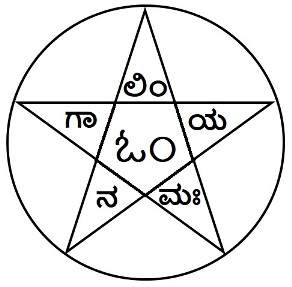 ಪಂಚಕೋನ ಪ್ರಣವ ಪಂಚಕೋನ ಪ್ರಣವ
|
Preparation of Sacred Water : Sacred ash (*Vibhuti*) should be applied to all five fingers. Using the thumb, while counting the three joints of the four fingers, the mantra “Om Shri Gurubasava Lingaya Namah” should be chanted 12 times. Then, with the middle finger, a pentagonal *Pranava* symbol should be drawn in the water, and all five fingers should be dipped into it to prepare the sacred water called *Manthrodaka* (also known as *Hastodaka*). Care should be taken to maintain cleanliness. The water should not be impure, dust should not settle on the Vibhuti, and the hands should be clean. . |
The Guru, after bathing, sits upon the sacred seat. The mother and child are bathed using the prepared sacred water and brought before the Guru. The Guru performs Ishtalinga worship and keeps the holy water (Theertha) aside. He sprinkles it upon the mother and child.
A folded cloth is spread across the Guru’s lap. Someone then places the baby, who had been lying on the mother’s lap, onto the Guru’s lap. Chanting:
“Om Shri Guru Basava Lingaya Namah”
the Guru applies sacred ash to the child’s forehead, hands, and navel.
If the child had already received Garbha Lingadharana (prenatal Linga initiation), the same Ishtalinga is purified and worshipped again. It is then tied around the child’s neck, and placing his hand on the child’s head, the Guru softly whispers:
“Om Lingaya Namah.”
If this is the child’s first Lingadharana, a new Linga or Nagosa is purified and worn.
Nagosa ನಾಗೋಸ = ಇಷ್ಟಲಿಂಗದ ಕಂಥೆ ಮಕ್ಕಳ ಸಲವಾಗಿ ಎರಡು ಕಡೆ ದಾರ ಕಟ್ಟಲು ಕೊಕ್ಕೆ ಆಕಾರ ವಿರುವುದು
Nagosa refers to the cord or necklace of the Ishtalinga, designed with hook-like shapes on both sides to tie the threads for children. |
Naming the Child
The Guru should announce the name desired by the family. If the family wishes the Guru himself to choose the name, then—with the family’s approval—the Guru announces it.
Everyone is then asked to repeat after him. First:
“Om Shri Guru Basava Lingaya Namah”
is recited, followed by the chosen name six times, such as:
- Basava Kiran
- Prabhudeva
- Siddesha
- Akkamahadevi
- Neelamma
Finally, all proclaim:
“Jaya Guru Basavesha Harahara Mahadeva!”
Culture in Naming
Culture is reflected in the naming of children and homes. The best practice is to name children after the great saints and spiritual leaders of the tradition such as Basava and other Pramathas. This is considered a noble way of remembering their sacrifices and contributions.
List of NamesExamples include:
- Basavanna
- Channabasavanna
- Prabhudeva
- Siddharameshwara
- Siddhalingeshwara
- Mahadeshwara
- Akkamahadevi
- Neelambike
- Nagalambike
- Kalyanamma
- Gangambike
Names may also be slightly modified to suit modern times, such as:
- Basava Kiran
- Basava Prasad
- Basava Prakash
- Basava Shri
- Basava Chandrike
- Basava Jyoti
- Vachana Shri
- Vachanambike
Names like:
- Mahalinga
- Gurulinga
are especially esteemed because they directly refer to divinity.
Shaiva cultural names are also acceptable. Though Basava Dharma is an independent religion, it maintains a deep cultural relationship with the Shaiva tradition. Therefore, names associated with Shiva—the primordial yogi—and Uma—the first yogini—are not considered outside Sharana culture.
Lingayat Names for Children
The third category of names may be drawn from nature, virtues, qualities, and noble characteristics.
It is considered inappropriate to use the names of other deities or minor folk gods. Elders’ names may be used if they are meaningful. This preserves both memory and culture.
Once the Guru formally announces the new name, the ceremonies of Lingadharana and naming are considered complete.
After this, the parents of the newborn take vows. The mother takes the vows while holding the baby on her lap.
Oath Ceremony of Followers of Basava (Lingayat) Dharma
Twelve Oaths of Basava (Lingayat) Dharma Followers
Om Shri Guru Basava Lingaya Namah
“In the witness of Dharma Guru Basavanna, in the witness of the Supreme Creator of the universe, and in the witness of all the sharanas, I accept this vow.
I surrender to Shri Guru Basava, I surrender to Lord Linga, I surrender to the assembly of sharanas, and I have attained the state of the gana.”
| 1 | OM (ಓಂ) | I believe in the existence of the Creator who made the universe. I surrender believing that He alone is the supreme power. |
| 2 | Shri (ಶ್ರೀ) | I place my faith in and surrender to Dharma Guru Basavanna, the divine emissary sent by God for the spiritual upliftment of humanity, born of divine grace and revered as the universal protector. |
| 3 | Gu (ಗು) | I accept the Vachana literature revealed by Guru Basavanna, the primal sharana, together with his contemporaries and the lineage of sharanas, as my religious code, and I commit myself to walking the sharana path. |
| 4 | Ru (ರು) | I shall faithfully wear the Ishtalinga, the symbol of the universal soul shaped by the Dharma fathers, and worship it daily with devotion. |
| 5 | Ba (ಬ) | I accept the divine field of Kudala Sangama, revealed by Dharma father Basavanna, as our sacred religious center and will visit it. |
| 6 | Sa (ಸ) | At least one day in every week, I shall join the company of sharanas, remember the Lord, praise the Dharma fathers, and participate in spiritual gatherings and experience-sharing assemblies. Every year, on Shivaratri, I will certainly take part in the local gana gathering. |
| 7 | Va (ವ) | I will earn wealth through truthful and pure work, and use it through the principle of dasoha (selfless sharing) for the upliftment of religion and society. |
| 8 | Lim (ಲಿಂ) | Every year, I will come to the Basava revolution day gathering at Kudala Sangama, the place of Basavanna’s learning, tapas, and union. At least once in my lifetime, despite all difficulties, I shall attend and affirm my religious commitment. |
| 9 | Ga (ಗಾ) | I will not desire others’ wealth or others’ wives. |
| 10 | Ya (ಯ) | I will not consume meat or alcohol. |
| 11 | Na (ನ) | We shall raise the child born to us, (the child’s name should be spoken), as a follower of the Lingayat religion and guide them forward on the path of Basava. |
| 12 | Maha (ಮಃ) | According to the vision of the Dharma fathers, I will faithfully strive to establish in this mortal world a divine welfare kingdom free from caste, color, and class divisions. |
| 1 | ಓಂ | ಜಗತ್ತನ್ನು ನಿರ್ಮಾಣ ಮಾಡಿದ ಸೃಷ್ಟಿಕರ್ತನ ಅಸ್ತಿತ್ವದಲ್ಲಿ ನಂಬಿಕೆ ಇಡುತ್ತೇನೆ. ಅವನು ಒಬ್ಬನೇ ಮತ್ತು ಪರಮೋನ್ನತ ಶಕ್ತಿ ಎಂದು ನಂಬಿ ಶರಣಾಗುತ್ತೇನೆ. |
| 2 | ಶ್ರೀ | ವಿಶ್ವಗುರು ಬಸವಣ್ಣನವರು ದೇವರು ಲೋಕೋದ್ಧಾರಕ್ಕಾಗಿ ಕಳುಹಿಸಿ ಕೊಟ್ಟ. ಪ್ರತಿನಿಧಿ, ಕಾರಣಿಕ, ದೇವರ ಕರುಣೆಯ ಕಂದ, ನಮ್ಮೆಲ್ಲರ ರಕ್ಷಕ ಎಂದು ನಂಬಿ ಶರಣಾಗುತ್ತೇನೆ. |
| 3 | ಗು | ಗುರು ಬಸವಣ್ಣನವರೇ ಆದಿ ಪ್ರಮಥರಾಗಿ, ಅವರ ಸಮಕಾಲೀನರು ಮತ್ತು ಅವರ ಪರಂಪರೆಯ ಶರಣರು ಕೊಟ್ಟ ವಚನ ಸಾಹಿತ್ಯವೇ ನನ್ನ ಧರ್ಮ ಸಂಹಿತೆ ಎಂದು ತಿಳಿದು ಶರಣ ಪಥದಲ್ಲಿ ನಡೆಯುತ್ತೇನೆ. |
| 4 | ರು | ಧರ್ಮಪಿತರು ವಿಶ್ವದಾಕಾರದಲ್ಲಿ ರೂಪಿಸಿಕೊಟ್ಟ ವಿಶ್ವಾತ್ಮನ ಕುರುಹಾದ ಇಷ್ಟಲಿಂಗವನ್ನು ಶ್ರದ್ಧೆಯಿಂದ ಧರಿಸಿ, ನಿಷ್ಠೆಯಿಂದ ನಿತ್ಯವೂ ಪೂಜಿಸುತ್ತೇನೆ. |
| 5 | ಬ | ಧರ್ಮಪಿತ ಬಸವಣ್ಣನವರು ಬಯಲಾದ ದಿವ್ಯಕ್ಷೇತ್ರ ಕೂಡಲ ಸಂಗಮವನ್ನು ನಮ್ಮ ಧರ್ಮಕ್ಷೇತ್ರವೆಂದು ನಂಬಿ ಸಂದರ್ಶಿಸುತ್ತೇನೆ. |
| 6 | ಸ | ಏಳು ದಿವಸಗಳ ವಾರದಲ್ಲಿ ಒಂದು ದಿವಸವಾದರೂ ಶರಣರ ಸಂಗದಲ್ಲಿ ಸೇರಿ ಕರ್ತನನ್ನು ಸ್ಮರಿಸಿ, ಧರ್ಮಪಿತರನ್ನು ಕೊಂಡಾಡಿ, ಗಣ ಮೇಳಾಪ-ಅನುಭವ ಗೋಷ್ಠಿಯಲ್ಲಿ ಭಾಗಿಯಾಗುತ್ತೇನೆ. ಪ್ರತಿವರ್ಷವೂ ಶಿವರಾತ್ರಿಯಂದು ಸ್ಥಳೀಯವಾಗಿ ನಡೆಯುವ ಗಣಮೇಳದಲ್ಲಿ ತಪ್ಪದೆ ಭಾಗಿಯಾಗುತ್ತೇನೆ. |
| 7 | ವ | ಸತ್ಯ ಶುದ್ಧ ಕಾಯಕದಿಂದ ಧನವನ್ನು ಸಂಪಾದಿಸಿ ದಾಸೋಹ ತತ್ತ್ವದ ಮೂಲಕ ಧರ್ಮ-ಸಮಷ್ಟಿಗಳ ಉದ್ಧಾರಕ್ಕೆ ವಿನಿಯೋಗಿಸುತ್ತೇನೆ. |
| 8 | ಲಿಂ | ವಿಶ್ವಗುರು ಬಸವಣ್ಣನವರ ವಿದ್ಯಾಭೂಮಿ, ತಪೋಸ್ಥಾನ, ಐಕ್ಯಕ್ಷೇತ್ರ ಕೂಡಲ ಸಂಗಮದಲ್ಲಿ ಪ್ರತಿ ವರ್ಷವೂ ಬಸವ ಕ್ರಾಂತಿ ದಿನದಂದು ನಡೆಯುವ ಶರಣ ಮೇಳಕ್ಕೆ ಬರುತ್ತೇನೆ. ಜೀವಮಾನದಲ್ಲಿ ಒಮ್ಮೆಯಾದರೂ ಎಷ್ಟೇ ಅನಾನುಕೂಲತೆಗಳಿದ್ದರೂ ಬಂದು ಭಾಗಿಯಾಗಿ, ನನ್ನ ಧಾರ್ಮಿಕ ಅನುಯಾಯಿತ್ವವನ್ನು ಸ್ಥಿರೀಕರಿಸುತ್ತೇನೆ. |
| 9 | ಗಾ | ಪರಧನ, ಪರಸ್ತ್ರೀಯರನ್ನು ಬಯಸುವುದಿಲ್ಲ. |
| 10 | ಯ | ಮಾಂಸಾಹಾರವನ್ನು, ಮದ್ಯಪಾನವನ್ನು ಮಾಡುವುದಿಲ್ಲ. |
| 11 | ನ | ನಮಗೆ ಜನಿಸಿರುವ ಮಗುವನ್ನು (ಹೆಸರು ಹೇಳಬೇಕು), ಲಿಂಗಾಯತ ಧರ್ಮಾನುಯಾಯಿಯನ್ನಾಗಿ ಮಾಡಿದ್ದು, ಬಸವ ಪಥದಲ್ಲಿ ಮುನ್ನಡೆಸುತ್ತೇವೆ. |
| 12 | ಮಃ | ಧರ್ಮಪಿತರ ಸಂಕಲ್ಪದಂತೆ ಮರ್ತ್ಯಲೋಕದ ಈ ಕರ್ತನ ಕಮ್ಮಟದಲ್ಲಿ ಜಾತಿವರ್ಣವರ್ಗರಹಿತ ಧರ್ಮ ಸಹಿತ ಕಲ್ಯಾಣ(ದೈವೀ) ರಾಜ್ಯದ ನಿರ್ಮಾಣಕ್ಕೆ ನಿಷ್ಠೆಯಿಂದ ಪ್ರಯತ್ನ ಮಾಡುತ್ತೇನೆ. |
Jaya Guru Basavesha, Harahara Mahadeva.
After this, the Guru should give *Karuna Prasada* (sacred blessed offering). He pours three drops of *Theertha* (holy water) into the baby’s mouth. Then, he sprinkles the holy water three times each upon the Ishtalingas of the mother and father and gives them the *Karuna Prasada*.
The mother should then place the baby on her lap, touch the child’s hand to the flowers, and offer those flowers to the image of Basava Guru. While chanting the Basava Linga mantra, floral worship (*Pushparchane*) should be performed, followed by the *Mahamangala* ceremony.
Everyone present should participate in the *Mahamangala* by offering flowers to Basava Guru. After offering the flowers and bowing in reverence, they should receive *Karuna Prasada* from the Guru, pay their respects, and depart.
A *Mahaprasada* meal (community feast) should be arranged for all who attend.
Cradle Ceremony
The cradle ceremony is a very joyful occasion for women. The friends of the newborn baby’s mother, along with close relatives and family members, gather together for the event. Until this point, the baby would have remained constantly with the mother, and now the practice of placing the child independently and safely in a cradle is formally begun. The ceremony also serves as an occasion to share the joy of the child’s birth with everyone.
The swinging cradle is beautifully decorated. Silk sarees, colorful flowers, pictures, toy parrots, sparrows, and other decorative items are tied around it. For the first childbirth, the woman’s parental family traditionally gifts a brand-new cradle to their daughter.
Near the cradle, a beautiful canopy or pavilion should be arranged, and a portrait of Guru Basavanna should be placed there and decorated. As everyone gathers, the adorned mother and baby should be brought in. The mother offers worship to Basaveshwara, completes the पूजा, and sits down.
First, members of the mother’s family fill the ceremonial lap (*udi tumbuvudu*) and present their gifts. Then the husband’s family similarly fills the lap and offers their gifts. Touching the feet of Guru Basavanna’s image and applying the sacred ash attached there onto their hands, the baby’s grandmother, aunts, and close relatives apply the Vibhuti to the child’s forehead and place the child into the mother’s lap. The gifts meant for the child are then handed to the child’s mother by members of both families.
Now the elder women apply sacred ash (*Bhasma*) to different parts of the cradle, thereby sanctifying it. After this, six people lift the worshipped portrait of Basavanna and place it in the cradle while chanting:
“Jaya Guru Basavesha Harahara Mahadeva!”
They then worship the portrait of Basava. (An empty cradle should not be worshipped; since it is a new object, applying Vibhuti to purify it is considered sufficient.)
Basava lullabies (*Basava Jogula*) are then sung.
ಬಸವ ಧರೆಗೆ ಬಂದ ಜೋ ಜೋ
ಬಸವ ಧರೆಗೆ ಬಂದ
ಕರ್ತನ ಕರುಣೆಯ ಬಾಳಲಿ ಹೊತ್ತು
ಮರ್ತ್ಯವ ಬೆಳಗಲು ಇಳೆಗೆ ತಂದ || ಅ.ಪ ||
ಅಕ್ಷಯ ತೃತೀಯ ವೈಶಾಖದಲ್ಲಿ
ಅಕ್ಷಯ ಮಾರ್ಗವ ತೋರಲಿಕೆಂದು
ನೊಂದ ಹೃದಯಗಳ ಸಂತೈಸಲೆಂದು
ಮಂದ ಮಾರುತದೋಲ್ ಲೋಕಕೈತಂದ
ಮಾದಲಾಂಬಿಕೆಯ ಮಮತೆಯ ಕಂದಾ
ಮಾದೇವರಸರ ವಂಶದ ಅಂದ
ಭಾರತ ಭೂಮಿಯ ಭಾಗ್ಯದ ಚಂದ
ಮನುಕುಲಕೆಲ್ಲ ಪರಮಾನಂದ
ಸಮತೆಯ ಕಹಳೆಯ ಮೊಳಗಲು ಬಂದ
ಕಾಯಕ ಕೈಲಾಸ ಎನ್ನುತ ನಿಂದ
ಕರ್ತನ ಮಹಿಮೆಯ ಸಾರಲು ಬಂದ
ಮರ್ತ್ಯದ ಸತ್ಯವ ತೋರಲು ಬಂದ
ಧರ್ಮದ ದಿನಮಣಿ ಶರಣರ ಕಣ್ಮಣಿ
ಧರೆಗುತ್ತಮ ಶ್ರೀ ಗುರುಚೂಡಾಮಣಿ
ದೀನದಲಿತರ ಬಾಳಿನ ಶುಭಖಣಿ
ಆಶ್ರಿತ ರಕ್ಷಕ ಚೆನ್ನ ಪರುಷಮಣಿ
ಜಯಜಯವೆನ್ನುತ ಹಾಡಿ ಹರಸಿರಿ
ಜೋ ಜೋ ಎನ್ನುತ ತೊಟ್ಟಿಲ ತೂಗಿರಿ
ಮಂಗಲದಾರತಿ ಪ್ರೇಮದಿ ಬೆಳಗಿರಿ
ಭುವನದ ಭಾಗ್ಯ ಬಸವಗೆ ನಮಿಸಿರಿ
ಪಲ್ಲವಿ ಹೇಳುವಾಗ ಎಲ್ಲರೂ ಜೋ ಜೋ ಎಂದು ಧ್ವನಿಗೂಡಿಸಬೇಕು.
Basava Has Come to the Earth — Jo Jo
Basava has come to the earth
Carrying the life of the Creator’s compassion,
He came down to this world to enlighten humanity. || Chorus ||
On the sacred Akshaya Tritiya in the month of Vaishakha,
He came to show the eternal path,
He came to console wounded hearts,
He came to the world like a gentle breeze.
Beloved child of Madalambike’s affection,
The pride of Madevarasa’s lineage,
The beautiful fortune of the land of Bharata,
Supreme bliss for all humankind.
He came to sound the trumpet of equality,
Declaring “Work itself is Kailasa,”
He came to proclaim the glory of the Creator,
He came to reveal the truth of mortal life.
Sun of Dharma, jewel among Sharanas,
Supreme crest-jewel Guru upon the earth,
Auspicious treasure in the lives of the poor and oppressed,
Protector of those who seek refuge, noble precious gem.
Sing praises saying “Victory! Victory!” and bless him,
Rock the cradle singing “Jo Jo,”
Light the auspicious Aarti with love,
Bow to Basava, the fortune of the world.
When the refrain is sung, everyone should join together by chanting “Jo Jo.”
In some places, it is said that a grinding stone is first placed in the cradle and gently rocked before the baby is placed in it, with the belief that the child will grow strong and healthy like the stone. However, a grinding stone is an inanimate object. Apart from physical existence, it has neither intellectual nor spiritual significance. Therefore, this practice is considered inappropriate. Placing the portrait of Basava Guru first is regarded as far more meaningful and symbolic.
An *Aarti* should then be performed for the mother and child. A respected elder woman takes the baby in her arms and formally announces the child’s name:
“O Sharana brothers and sisters, the auspicious name of this child will now be announced. Please all repeat after me.”
“Om Shri Gurubasava Lingaya Namah
Allama Prabhu, Allama Prabhu, Allama Prabhu”
The person leading and the others repeating together should say the name six times. Then six women place the baby in the cradle and collectively proclaim: “Jaya Guru Basavesha Harahara Mahadeva!”, First, they sing this lullaby:
ಜೋ ಜೋ ಜೋ ಕಂದ ಪರಮಾನಂದ
ಮುದವನು ತಾ ತಂದ ಒಲವಿನ ಕಂದಾ ||ಜೋ ಜೋ ||
ತಾಯಿ ತಂದೆಯರ ಪ್ರೇಮದ ಅರಗಿಣಿ
ಬಂಧು ಬಾಂಧವರ ಮುದ್ದಿನ ಕಣ್ಮಣಿ
ವಂಶದ ಆಗಸದಿ ಚೆಲುವಿನ ದಿನಮಣಿ
ದಿನದಿನಕೆ ಬೆಳೆಯುತ ಆಗು ನೀ ಗುಣಮಣಿ ||ಜೋ ಜೋ ||
ಆರೋಗ್ಯ ಆಯುಷ್ಯ ಸಂಪ್ರಾಪ್ತವಾಗಲಿ
ವಿದ್ಯಾಬುದ್ದಿಗಳು ಎಂದೆಂದು ನಿನಗಿರಲಿ
ಸಂಪತ್ತು ಸಂತೋಷ ಸಂತೃಪ್ತಿ ದೊರಕಲಿ
ನೂರು ವರುಷ ಕಾಲ ಬದುಕುವ ದೆಸೆಯಿರಲಿ ||ಜೋ ಜೋ ||
ಜಗದೊಡೆಯ ದೇವನ ಕರುಣೆ ಕಾಪಾಡಲಿ
ಗುರುಹಿರಿಯರೆಲ್ಲರ ಒಲವಿನ ಬಲವಿರಲಿ
ಶರಣರ ಪಥದಲ್ಲಿ ಸಾಗುವ ಛಲವಿರಲಿ
ಗುರುಬಸವ ತಂದೆಯ ಶ್ರೀರಕ್ಷೆ ನಿನಗಿರಲಿ ||ಜೋ ಜೋ ||
**Jo Jo Jo Kanda Paramananda**
Child of supreme bliss,
Beloved child who has brought us joy. || Jo Jo ||
Precious jewel born from the love of your parents,
Darling gem cherished by relatives and family,
Beautiful sun shining in the sky of the lineage,
Grow day by day and become a jewel of virtue. || Jo Jo ||
May you gain health and long life,
May wisdom and knowledge always be yours,
May wealth, happiness, and contentment come to you,
May you live for a hundred years. || Jo Jo ||
May the compassion of the Lord of the world protect you,
May the affection and blessings of Gurus and elders strengthen you,
May you have the determination to walk the path of the Sharanas,
May Father Guru Basava’s divine protection always be with you. || Jo Jo ||
The remaining women should join in by repeating “Jo Jo” in chorus. An *Aarti* should then be performed for the baby. Afterwards, all the guests may gently rock the cradle, perform *Aarti*, and offer gifts to the baby and the mother. Sweets, fruits, betel leaves and nuts (*tambula*), and Vachana literature may also be distributed as much as possible.
After the Lingadharana ceremony, it is considered good for the child to wear the Ishtalinga around the neck. However, silver lockets and similar ornaments are not practical for children. There may be fear of it pressing against the body, and also fear of theft. Therefore, wearing a *Nagosa* is preferable.
If an artificial gold chain is worn with the Nagosa tied at its end, and if it is made well, the Linga shines beautifully and enhances the child’s appearance.
According to Basava Dharma, the Ishtalinga should remain on the body continuously from birth until death. When the child begins attending school, there is no need to feel shy if other children ask questions about it. The family should teach the child to answer confidently.
Going to Basavanna’s Shrine (Mantapa)
A custom has developed in which the mother who has recently given birth visits the shrine within one month after delivery. The purpose behind this practice is:
1. To offer gratitude to God for a safe and successful childbirth.
2. To help the woman, who had become socially separated during pregnancy, gradually rejoin and mingle with society after delivery.
There is a traditional practice of first visiting Basavanna’s shrine (that is, the Basava Mantapa), where all members of the community gather. If there is no Basavanna shrine, people visit whatever place of worship is available and feel satisfied with that. Among Christians, churches exist and the child’s baptism is conducted there itself; thus they maintain a certain uniform discipline.
Followers of Basava Dharma should visit the Basava Mantapa or Basavanna’s shrine, perform the first worship and darshan, and receive blessings. If there is a Guru’s monastery (*Matha*), they may visit there and receive blessings.
If none of these exist in the village (such neglected villages also exist), and only shrines of minor deities are present—for example Mari, Masani, or Yellamma—then one should not go there. Principled Lingayats should act in this way.
If among their relatives and friends there are cultured and spiritually minded people, then Basaveshwara worship may be arranged in their house, and the mother and child may go there and receive worship and blessings. The baby should be laid before the sanctum, worship and *Mangalarati* performed, sacred ash applied to the child’s forehead, and the *Aarti* flame touched to the eyes. If Gurus are available, one may bow to them and receive sacred ash from them.
Some other customs also existed in earlier times. One such practice was that the father would not directly look at the baby’s face until certain religious rites were completed, and he would “see the face” (*mari noduvudu*) only in the 1st, 3rd, 5th, 9th, or 11th month. This is considered completely irrational. Naturally, the father is eager to see the child and usually arrives as soon as he hears the news of the birth. Therefore, it is reasonable that the father participates along with the mother and child in all ceremonies such as Lingadharana.
Similarly, there is the practice of ear piercing. Earlier, it was done by goldsmiths or traditional artisans (*Panchala Pattara*). Now it is safer in every respect to have it done by doctors, as there is no danger of infection.
Even today, in some subgroups of the Lingayat community—especially among the Nagarthas (descendants of Veerabhadra’s lineage)—ear piercing is celebrated as an expensive and grand ceremony involving fasting and elaborate observances. Why such magnificence became attached to such a small and insignificant act is difficult to understand.
Within three months after the child’s birth, the woman returns to her husband’s house from her parental home carrying the cradle and baby items. At the doorway, *Aarti* is performed for the mother and child before they are welcomed inside.
The old custom called “seeing the birth room” has now lost its meaning. Earlier, after taking the child to the husband’s home, the mother was expected to return within a month to visit the room where the child was born. Likewise, when the baby was four months old, the maternal uncle would formally come and ceremonially show the child the sun during the day and the moon at night. All these customs have now lost their original significance.
Naming and Cradle Ceremony Invitation
Sample Invitation Letter for Naming and Cradle Ceremony
Lingadharana – Naming – Cradle Ceremony
Om Shri Guru Basava Lingaya Namah
Basaveshane Basavarajane Basavannane Basavatande
Basava Krupanidhi Basava Parameshwarishwara Basava,
Pramathadideva Rakshisu Basava
Affectionate Invitation for the Naming and Cradle Ceremony
Respected Sharana relatives and friends,
By the grace of the Creator and Dharma Guru Basavanna, we have been blessed with the birth of our son/daughter. On date ____________, on ____________ (day), at ____________ (time), at ____________, the ceremony of Lingadharana – Naming – Cradle Ritual will be conducted.
The revered ____________________________________________ will graciously bless the occasion.
We warmly invite you to attend, bless the child, and accept the Mahaprasada that we shall offer in the spirit of Dasoha.
Address:
__________________________________________
__________________________________________
With Sharanu and Sharanaarthi greetings,
Sharana / Sharane __________________________________
__________________________________________
Note: The above content has been translated by Shivshanker Cheral using AI tools. If any mistake please report to admin. It is based on the writings of Dr. Maate Mahadevi in her book Basava Dharmada Samskaragalu in Kannada. "ಬಸವ ಧರ್ಮದ ಸಂಸ್ಕಾರಗಳು", ಲೇ:ಪೂಜ್ಯ ಶ್ರೀ ಮಹಾಜಗದ್ಗುರು ಡಾ|| ಮಾತೆ ಮಹಾದೇವಿ, ಪ್ರ: ವಿಶ್ವಕಲ್ಯಾಣ ಮಿಷನ್, ಬೆಂಗಳೂರು, ೧೯೯೫.
| Siddharameshwara_Vachana :👈 | 👉:Javala-The-First-Tonsure-Ceremony |